

Warehouse Orchestration Software That Unifies Your Operation
Disconnected systems. Unpredictable demand. Automation that does not behave the same hour to hour. LogistiVIEW warehouse orchestration software coordinates your people, automation, and processes in real-time so work stays balanced, flow stays stable, and you can scale without losing control.
The Orchestration Gap Is Costing You
Most warehouses are not struggling because they picked the wrong system. They are struggling because their systems do not execute as one operation. When WMS logic, automation logic, and day to day decision making are split across tools, your team becomes the orchestration layer.
Disconnected Systems
- WMS, ERP, WCS, and robotics platforms working in isolation
- Handoffs between people and machines rely on manual coordination
- Critical information trapped in separate platforms delaying decisions
Coordination Overhead
- Warehouse supervisors managing queues and exceptions instead of performance
- Task assignment driven by static plan or instinct instead of real-time conditions
- Bottlenecks forming while capacity sits idle elsewhere
Limited Adaptability
- Can’t respond quickly to demand spikes, labor gaps, or exceptions
- Changes require IT involvement, workarounds or difficulty updates
- Scaling means adding complexity, not capability
What Is Warehouse Orchestration?
Warehouse orchestration is real-time flow control across your operation. The system continuously rebalances so work moves through your operation at the pace each process can handle, resources are used where they matter most, and performance stays steady even when conditions shift.
LogistiVIEW WES creates this unified execution layer without replacing your existing systems. Instead, it connects and coordinates what you already have, including WMS, automation, devices, and people to eliminate gaps and enable seamless coordination across your entire operation.
How orchestration delivers stability:
- Real-time flow control between picking, replenishment, packing, sortation, staging, and loading so no zone is overwhelmed or idle
- Continuous rebalancing of people, robots, and equipment so capacity stays aligned to the true constraint
- Order movement driven by actual constraints instead of fixed release rules, reducing spikes, backlog, and idle pockets
- Dynamic task assignment based on position, readiness, and capability so every task goes to the resource best positioned to finish it now
- A stable operation that holds cycle times and throughput even as order mix, staffing, priorities, and equipment readiness change throughout the day

Breaking Down Siloed Systems
The fundamental challenge in modern warehouses isn’t technology. It’s coordination. Your WMS manages inventory, your WCS controls automation, and your ERP drives orders. Each does its job, but they do not naturally align priorities, timing, and pacing across the operation. This disconnect creates conflicting queues and mismatched decisions that force supervisors to reconcile conflicts manually.

The Manual Coordination Tax
When systems operate in silos, someone has to bridge the gaps. Supervisors spend their days reconciling task lists, clearing stuck orders, chasing missing inventory, and rebalancing queues between tools that are not designed to coordinate with each other. Work sits waiting while leaders manually triage which system’s priorities take precedence.

How Warehouse Orchestration Eliminates Silos
LogistiVIEW WES replaces manual work created by siloed systems by aligning execution to one set of priorities and one operating pace. Your WMS, automation, labor tools, and equipment follow the same decision logic and timing, so supervisors stop acting like the integration layer.
Unified execution across systems:

- Eliminates mismatched task lists and competing priorities that force manual reconciliation
- Coordinates work between WMS and automation so work advances in the right sequence instead of being held up by differences in logic or timing
- Reduces manual triage and rework, freeing teams from constantly reassigning tasks or clearing stuck orders
- Absorbs system differences in real-time, allowing you to add new automation or workflows without breaking flow or creating weeks of manual adjustments
When warehouse order orchestration unifies your systems, your operation transforms from a collection of independent tools that require constant supervision into a cohesive environment that coordinates flow as one system.
Warehouse Automation Orchestration: Keeping People and Robots in Sync
Automation orchestration protects throughput by keeping people and automation in sync, preventing machines from becoming bottlenecks and ensuring your operation gets the full performance and ROI it invested in.

Automation Becomes a Bottleneck Without Orchestration
AMRs, goods-to-person, shuttles, sorters, conveyors and stations only perform well when they receive work at the pace they can actually handle. Without orchestration, automation backs up, starves, or causes slowdowns that ripple across your building undermining the efficiency gains you invested in.
How Warehouse Automation Orchestration Delivers Performance
LogistiVIEW WES regulates flow into automation, coordinates multiple automation types as one system, and dynamically balances work between people and machines based on real-time conditions.

Keeping automation from becoming a bottleneck:
- Regulates work flow so automation never backs up, starves, or causes slowdowns that ripple across the building
- Uses people and automation where each creates the most value. Human operators handle exceptions and judgment-based tasks while automation absorbs high-volume, repetitive work
- Protects throughput when automation performance changes due to charge cycles, congestion, or maintenance by leaning on human labor when automation slows
- Coordinates multiple types of automation, like AMRs, conveyors, shuttles, sorters, goods-to-person systems, as one connected environment instead of isolated islands

Reducing the risk of adopting automation:
Warehouse automation orchestration helps teams ramp up new technology without disrupting daily performance. You can introduce automation gradually, shift work between manual and automated paths as you learn, and adapt in real time without redesigning processes or rewriting logic.
Order Flow: Moving Work at the Right Pace
Order flow orchestration focuses on how work moves between processes, using real-time conditions to regulate pacing so each area receives only the volume it can handle. This keeps your entire operation running in a controlled, continuous flow.
Why Fixed Release Rules Fail
Traditional WMS logic releases work based on predefined waves or fixed rules that don’t account for current operational reality. They ignore downstream capacity, equipment readiness, and labor availability. This creates surges that overwhelm downstream processes, starves zones when work releases too slowly, and forces managers to manually intervene when priorities shift.
How Warehouse Order Orchestration Controls Flow
LogistiVIEW WES regulates how work moves between picking, replenishment, packing, sortation, staging, and loading so each process receives only the volume it can actually absorb.
Real-time flow control delivers
- Pacing based on current capacity instead of predefined release rules, preventing surges and protecting downstream steps
- Continuous monitoring of staffing, equipment readiness, backlog, and task mix before sending more work forward
- Constraint-based order movement that considers inventory availability, slot conditions, automation status, and priority shifts in real time
- Adaptive sequencing that reorders work as conditions change so high-priority orders advance without destabilizing the process
- Consistent flow that reduces variability, compresses cycle times, and enables higher volume without changing staffing levels
The continuous flow advantage
By moving orders at the pace your system can support, LogistiVIEW WES creates predictable throughput and eliminates the stop-and-go patterns caused by fixed waves or manual decisions. Your operation runs in a steady rhythm instead of alternating between idle periods and emergency catch-up.
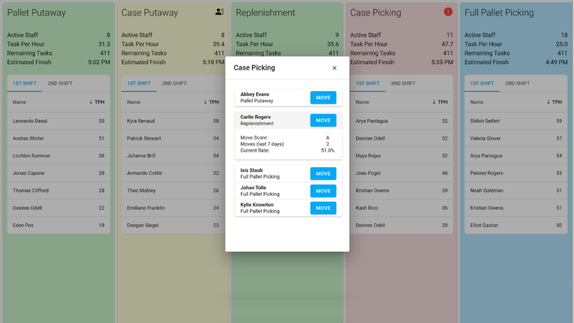
Zone Balancing: Intelligent Workload Distribution
Even with unified systems and coordinated automation, warehouses still struggle with uneven workload distribution. Some zones become bottlenecks while others sit underutilized, creating inefficiency and missed deadlines.

Why Zone
Imbalance Happens
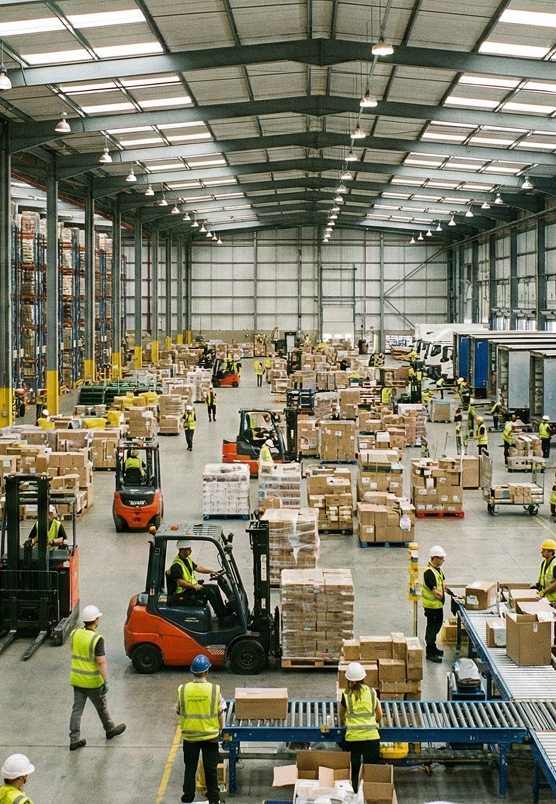
Traditional systems assign work based on inventory location or predefined rules, not on real-time capacity. High-velocity areas overload while other areas sit idle. By the time managers recognize the bottleneck and redirect resources, performance has already suffered.
How Warehouse Orchestration Enables Dynamic Zone Balancing
LogistiVIEW WES continuously monitors workload, capacity, and constraints across every zone. Rather than following static rules, the system dynamically balances work distribution to maintain optimal flow and prevent bottlenecks before they form.
Continuous rebalancing delivers:
- Real-time capacity awareness that tracks current capacity of every zone and resource
- Intelligent work routing that considers the entire operational picture when assigning tasks
- Predictive load management that anticipates where imbalances will occur and proactively adjusts work distribution
- Cross-zone flexibility that dynamically expands picking into reserve locations or activates alternative pack stations during high-volume periods
- Steady performance as the system constantly re-evaluates and adjusts distribution to maintain optimal balance throughout the day
Zone balancing isn't a one-time adjustment. It's continuous control that means more predictable throughput, better resource utilization, and higher capacity.
Inventory Orchestration: Real-Time Intelligence Beyond Your WMS
Inventory orchestration adds the real-time intelligence your WMS doesn’t provide by using live inventory readiness, slot demand, and pick-face conditions to drive tasking, replenishment timing, and flow decisions.
The WMS Limitation
Your WMS maintains inventory records and tracks locations, but it doesn’t account for real-time operational conditions. Tasks release before product is truly available. Replenishment doesn’t adjust when order mix shifts. Pick-face conditions that affect execution aren’t visible to the system releasing the work.
How Warehouse Orchestration Enhances Inventory Management
LogistiVIEW WES works with your existing WMS, adding operational intelligence that drives better execution without replacing your system of record.
Real-time inventory intelligence:
- Uses live inventory conditions rather than static records, checking slot status and replenishment timing so pickers aren’t sent to empty or blocked locations
- Coordinates replenishment with actual demand, adjusting timing and volume automatically when order mix shifts
- Routes work based on true availability and slot conditions, reducing short picks, relocations, and emergency fixes
The orchestration advantage:
Work advances only when inventory can support it now, which keeps order flow predictable and eliminates unnecessary travel. Your WMS remains your system of record for inventory, while warehouse automation orchestration ensures execution decisions reflect current operational reality.

The LogistiVIEW Difference

Built for Orchestration First
Unlike WMS platforms that added orchestration as an afterthought, LogistiVIEW WES was designed from the ground up for true system-agnostic integration and sophisticated coordination.

Technology-Agnostic Approach
Works with the systems and equipment you already have. Add new capabilities or switch vendors without disruption.

Operational Logic Grounded in Reality
Orchestration decisions reflect real constraints across labor, automation, and inventory readiness, not assumptions baked into static rules.

Scalable Architecture
Start by orchestrating a single process, then expand to full facility coordination. Modular implementation reduces risk while building toward comprehensive orchestration.
Ready to Unify Your Operation?
Join the companies that have eliminated siloed systems, balanced workload across zones, coordinated diverse automation, and transformed inventory management through LogistiVIEW WES.