

In the race to modernize warehouses and distribution centers, automation often takes center stage. Companies invest heavily in robotics with the goal of boosting throughput, reducing labor costs, and keeping pace with rising customer expectations.
But there’s a common trap we see time and again: optimizing your robots without optimizing your people.
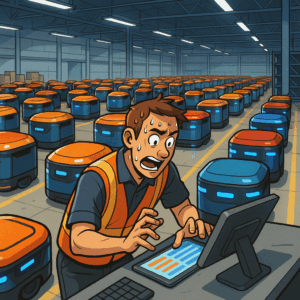
The Real-World Impact of a Lopsided Optimization Strategy
Let’s say you’ve deployed AMRs to streamline case picking or zone transfers. The robots are working efficiently, but pick rates aren’t improving as much as expected. Labor costs remain stubbornly high. Or worse, your robotic system is idle, waiting on people to catch up or finish unrelated tasks.
Why does this happen?
Because people and automation don’t operate in isolation. They share space, share work, and rely on each other. And if your systems treat them like independent components instead of parts of one coordinated operation, you’re leaving value on the table.
Here are a few common pitfalls we see:
- Labor blind spots. Many robotic platforms assume people are static resources. But people move, adapt, take breaks, and get reassigned. Without real-time awareness of human labor, your robots may be running at full speed while your pickers are overwhelmed—or vice versa.
- Limited Orchestration. While most robotics systems have limitations around SLA management and work prioritization, they don’t always prioritize the “best” work.
- Siloed execution. Automation vendors often provide software to control their hardware, but not the surrounding workflows. People still operate on paper or in disconnected apps. There’s no central orchestration layer to keep everyone aligned.
The Case for a Unified Execution Platform
This is where a Warehouse Execution System (WES) like LogistiVIEW makes all the difference.
LogistiVIEW is built to optimize all labor—robotic and human—under one intelligent execution layer. Instead of treating people as an afterthought, we treat them as essential parts of the execution environment.
Here’s how LogistiVIEW bridges the gap:
- Unified task management. Every task, whether destined for a robot or a person, lives in the same intelligent queue. This enables dynamic prioritization, load balancing, and bottleneck avoidance.
- Real-time labor awareness. LogistiVIEW tracks not just what robots are doing, but where your people are, what they’re working on, and how busy each zone is. It continuously rebalances the workload across all resources.
- Flexibility in execution. When an AMR system is overloaded, LogistiVIEW can divert work to human labor. When people fall behind, work can be offloaded to automation. You get built-in resiliency.
- Data-driven decisions. With unified reporting and task history, you get actionable insights about how your whole operation—robots and people—are performing together.
Don’t Let Your Robots Work Alone
Investing in automation is a smart move, but only when paired with an equally smart approach to orchestrating human work. A robot that’s waiting on a person is just an expensive speed bump. A picker working without visibility into automation is flying blind.
The most successful operations are the ones that blend people and automation into a single, seamless execution strategy. That’s what LogistiVIEW was built for.
Let’s talk about how we can help your team get the most out of both your automation investments and your people.
